 World Connect News
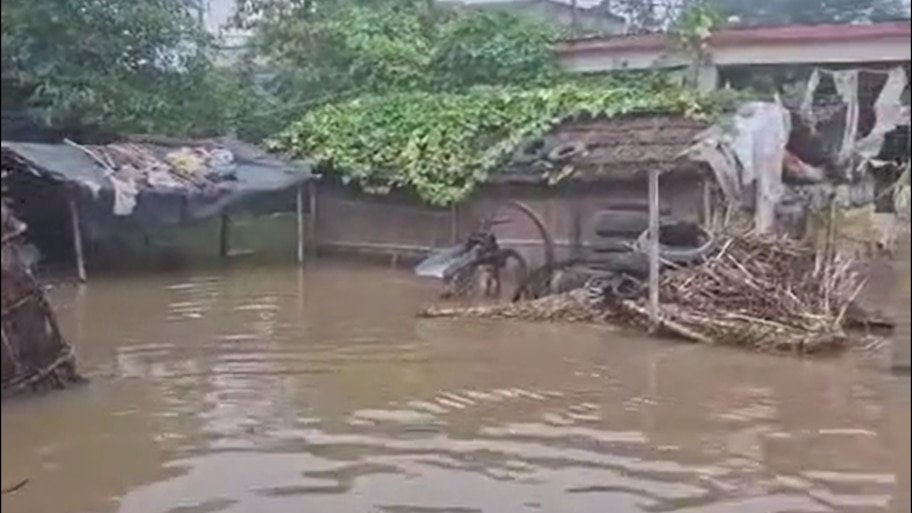
The historical ‘Raghopur Diara’, located just opposite Bihar’s capital Patna and under the administrative jurisdiction of Vaishali district, has currently taken water-samadhi due to the terrible surge of river Ganga. A total of 74 villages of all 20 panchayats of this huge island block surrounded by both the banks of river Ganga have been completely submerged in flood water. According to the Water Resources Department and the Central Water Commission, the water level of the Ganga is continuously flowing 1.5 to 2 meters above the danger mark, due to which the strong currents of the river have crossed the embankments and safety dams and directly entered the settlements. Residential areas of all the panchayats including Raghopur East, Raghopur West, Jahangirpur, Jugnavanpur Barari, Jugnavanpur Karari, Fatehpur, Chaksingar, Rampur Shyamchand, Bidulia, Rustampur, Shivnagar, Paharpur, Baharampur and Tersia have been flooded with water up to 5 to 8 feet. At this time, the entire Raghopur looks like a huge sea, where as far as the eye can see, only water waves and sinking roofs of houses are visible. At the ground level, all the means of transport, link roads, culverts and link roads have been completely cut off due to which more than 3 lakh population has become isolated from the mainland and have become hostages in their own homes.
The havoc of flood in Raghopur is so terrible that the first floor (ground floor) of people’s houses is completely submerged in water. Boxes, grain bins, beds, gas cylinders and stoves, everything has been submerged. To save their lives, villagers along with their small children, women and elderly people are forced to spend day and night by stretching tarpaulins on the roofs of pucca houses. Those who had only kutcha or hut-like houses, have built high scaffolding made of bamboo and poles inside their houses and are sitting on them or are risking their lives and taking shelter on the high mounds and platforms of the temples in the village. The biggest crisis in the area is reaching safe places. The few government boats run by the administration on a population of lakhs are proving to be ‘cumin in the camel’s mouth’. Private boat drivers are charging arbitrary fare to take each person to Gaighat in Patna or the coastal ghats in Hazirpur. Poor and helpless villagers, who are unable to pay, are making dangerous attempts to move to safer places, risking their lives, through the waves of the raging Ganga with the help of banana sticks, thermocol and wooden planks.
Amidst this orgy of floods, the most serious challenge facing the villagers is to quench the hunger in their stomach and the thirst in their throat. Almost all the government and private hand pumps installed in the villages have been submerged in the dirty flood water, due to which smelly and contaminated water is coming out from the taps. The pipelines and motor pumps of the Chief Minister Rural Drinking Water Nishchay Yojana (tap water for every house) have stopped due to submergence in water. Under compulsion, people are forced to drink the muddy and contaminated water of the same flood by filtering it with alum or cloth, due to which the outbreak of water-borne diseases like vomiting, diarrhea, dysentery and stomach ache has started spreading rapidly among children and elderly people.
The condition of humans as well as mute animals has become even more heartbreaking. Milch animals are the main basis of livelihood of the farmers of Raghopur. Hundreds of acres of green grass, char and straw reserves have rotted in the water. There is not even a piece of dry land left to keep cattle. Villagers are forced to keep their cows and buffaloes tied to the roofs or in water up to their necks. Due to lack of fodder and food, many cattle are dying of hunger and thirst, due to which foul smell is spreading in the entire area and there is a serious possibility of spread of epidemic.
The deluge has paralyzed the entire administrative and social structure of Raghopur. The Primary Health Center (PHC), Additional Health Sub-centre, Panchayat Bhawan and all primary and middle schools are submerged in 4 to 6 feet of water. Medicines and medical equipment have been damaged due to flooding in hospitals, making it impossible for doctors and health workers to sit. If a pregnant woman goes into labor or a sick elderly person deteriorates, there is no stretcher or ambulance boat available to take him to the hospital.
Along with this, due to flood water reaching the electricity sub-stations and transformers, the Electricity Supply Department has cut off the electricity in the entire Raghopur block for safety reasons. For the last several days, the entire Diara area is engulfed in dense darkness as the evening approaches. Due to the end of backup of mobile towers, the network has completely disappeared, due to which people trapped on the rooftops are not able to even inform their relatives living outside about their well-being. The incidents of poisonous snakes, scorpions and poisonous insect bites entering the houses with flood water in the dark have increased the panic of the villagers manifold.
There is huge resentment and anger towards the local administration and government among the flood victims of Raghopur. Even though on paper, claims of comprehensive relief and rescue are being made by the Disaster Management Department, on the ground, distribution of dry ration (chuda, jaggery, sattu, matchsticks, candles) or polythene sheets has not yet reached most of the panchayats.
Local villagers say that every year when floods occur, they are left to fend for themselves like this. There is deep anger among the people regarding the absence of big political faces and public representatives elected from this area. Villagers say that when they have to ask for votes, leaders come on boats, but when the entire area is drowning and children are crying for every penny, no one is going to take care of them. The victims have demanded that big motorboats of the Army, NDRF and SDRF should be immediately sent to all 20 panchayats, government community kitchens should be started at higher places and medical teams should be sent door-to-door through boats to distribute ORS, chlorine tablets and anti-venom injections.
This devastation has completely broken the economic backbone of the farmers of Raghopur. Diara region is known for its fertile soil, large-scale cultivation of vegetables, parwal, maize, banana and paddy crops. The crops flourishing in thousands of acres have now rotted under water, due to which months of hard work and loans worth lakhs of rupees of the farmers have been washed away in the water. Due to the sinking of fields, agricultural laborers are facing a deep crisis of livelihood.
If the flood water continues like this for the next few days, then there is a danger of the land becoming barren due to silt and erosion after the water recedes. The people of Raghopur are now demanding not only immediate relief but also immediate completion of the permanent concrete dam, repair of the ring dam and the construction of the bridge on the river Ganga to get rid of this annual tragedy. Until the water level of Ganga calms down and administrative help reaches the ground, every passing moment remains a battle between life and death for lakhs of residents of 74 villages of Raghopur.