 World Connect News
[ad_1]
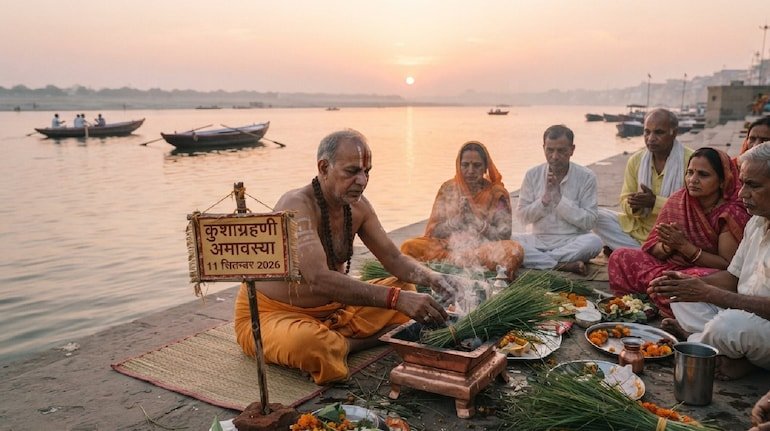
According to the Hindu calendar, the Amavasya date of Krishna Paksha of Bhadrapada month is called ‘Bhadrapada Amavasya’. It is also known as ‘Kushagrahani Amavasya’, ‘Kushotpatini Amavasya’ and ‘Pithori Amavasya’. This year, due to Amavasya Tithi falling two days later, there is confusion in the minds of people regarding its date.
According to Panchang calculations:
-
Amavasya Tithi Start: September 10, 2026 at 10:33 am
-
Amavasya date ends: September 11, 2026 at 08:56 am
According to the rules of the scriptures, the fast of Pithori Amavasya and the worship of Pradosh Kaal will be observed on 10 September 2026 (Thursday), because the Amavasya Tithi on the evening of 10 September will prevail in Pradosh Kaal. At the same time, in Sanatan Dharma, 11 September 2026 (Friday) will be the best and valid day for Udayatithi’s bath, Pitru Tarpan, Shraddha rituals and Kusha collection, because Amavasya Tithi will be present at the time of sunrise on 11 September.
In Sanatan Dharma, it is considered mandatory to have ‘Kusha’ (a special type of sacred grass) in any Havan, Puja, Yagya, Shraddha or Tarpan ritual. It is said in the scriptures that chanting and penance done without wearing the sacred ring of Kusha or without doing the asana of Kusha does not yield the full results.
Amavasya of the month of Bhadrapada is the only holy day of the year on which Kusha is uprooted and collected for religious purposes. It is a religious belief that the Kusha broken on this day with proper rituals and with Vedic mantras will be fulfilled. holy for a year It remains intact and can be used in all religious and Shraddha rituals throughout the year. If this Amavasya falls on Monday then that Kusha is considered usable for 12 years.
According to mythological belief:
Kushagre Vasate Rudra: In the midst of Kush, you are Keshav.
Kushmule Vased Brahma Kusham Me Dehi Medini.
That is, Lord Shiva (Rudra) resides in the front of Kusha, Lord Vishnu (Keshav) resides in the middle and Brahma ji resides in the root (root). Therefore it is considered to be the form of the real Trinity.
Special guidelines for Kusha collection have been given in religious texts, which are mandatory to follow:
-
Collection at sunrise: Kusha should be collected only in the morning, after bathing, facing east or north.
-
Unbroken and green kusha: Kusha should be completely green, clean and unbroken (not cut, torn or burnt).
-
Prohibited places: Collection of Kusha growing in dirty places, cremation grounds, intersections, near drains or roadsides is completely prohibited for religious purposes.
-
Do not use iron: Kusha should never be cut with iron tools, scissors or a scalpel. It is uprooted along with the roots in one stroke with the right hand.
-
Pronunciation of Mantra: While uprooting the bush, the mantra ‘Om Hum Phat’ should be chanted while seeking forgiveness from Mother Earth.
Bhadrapada Amavasya is also considered very special for the satisfaction of ancestors, because immediately after this, Pitru Paksha (Shraddha Paksha) arrives in the coming days. On this day, taking a bath in a holy river or in water mixed with Ganges water at home and offering it to the ancestors along with sesame seeds and kusha gives relief from Pitra Dosh. Along with this, married mothers observe Nirjala fast on Pithori Amavasya on this day and worship 64 Yoginis and Sapta Matrikas for the long life, good health and protection of their children.