 World Connect News
[ad_1]
The firestorm that has been simmering for months in the Middle East has finally erupted into a devastating direct military confrontation. The Aerospace Force of Iran’s elite military branch ‘Islamic Revolutionary Guard Corps’ (IRGC) has launched a fierce attack with several powerful anti-ship ballistic missiles, directly targeting a huge aircraft carrier and guided-missile destroyer of the US Navy patrolling in the territorial waters. An official military statement issued by Iranian state media and state broadcaster IRIB claimed that US warships were harassing Iranian merchant ships and actively engaging in a naval blockade of the Islamic Republic. Tehran claimed that after its missile attacks, US warships were forced to leave the conflict zone due to fear of heavy losses. This unexpected and direct attack by Iran has shocked the entire world, because this is the time after decades that the Iranian military has openly fired its deadliest ballistic missiles at the top warships of the US Navy.
Immediately after this audacious attack by Iran, the United States Department of Defense (Pentagon) and the US Central Command (CENTCOM) issued official statements rejecting Iranian claims. US Central Command has confirmed that Iran fired multiple ballistic missiles at a US aircraft carrier and guided-missile destroyer on routine patrol in regional waters. However, with the help of the state-of-the-art Aegis Missile Defense System and electronic counter-measures deployed on American warships, the American ships successfully dodged the Iranian missiles. The Pentagon clarified that no American soldier was injured in this attack nor was there any structural damage to the ships. Washington termed the attack as an ‘unprovoked and cowardly act’ and said that Tehran would have to pay a heavy price for targeting US naval assets in international waters.
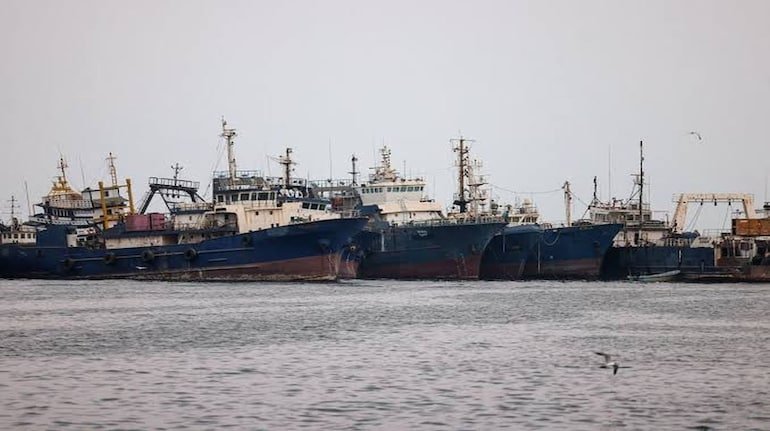
Within hours of the Iranian attack, the US military launched a devastating counterattack that directly hit the backbone of the Iranian economy. On the direct orders of Admiral Brad Cooper, Commander of US Central Command, the US Air Force and Navy conducted coordinated air strikes targeting three huge crude oil tankers belonging to the Iranian Revolutionary Guards. The US Army, through satellite and precision missile attacks, permanently disabled the crude oil tankers ‘M/T Downy’ present in the coastal waters of Kharg Island and ‘M/T Stark 1’ near Jask. Apart from this, the third oil carrier ‘M/T Kylo’ (M/T Kylo, also known as Noxon) present in the Gulf of Oman was accurately attacked and sunk in the depths of the sea.
The US Central Command released the video footage of this gruesome attack and also presented evidence of its action to the world. Admiral Brad Cooper issued a direct and open warning to the IRGC, saying, “Our message to the Revolutionary Guards must be very clear—if you fire on two of our ships, we will destroy three of your ships and extract even greater economic damages from you. We will not hesitate for a second in defending U.S. forces and, if necessary, we will completely destroy Iran’s limited and unprotected oil fleet.” US officials said that these three tankers were part of Iran’s multi-billion dollar ‘shadow network’, the income from which the IRGC funds its proxy groups and military operations.
The world’s most strategically sensitive sea route, the ‘Strait of Hormuz’, has become the focal point of this bloody conflict in the sea between America and Iran. About 20 percent of the world’s total oil consumption passes through this narrow waterway. Following this latest missile attack and the destruction of the tankers, commercial maritime traffic passing through Hormuz has reached a historic low. Global shipping companies have blocked the passage of their giant oil tankers through the Persian Gulf and the Gulf of Oman altogether or diverted them onto the long detour route to Africa. Due to this unprecedented naval standoff, a huge jump in the prices of Brent Crude Oil and WTI Crude has been recorded in the international commodity markets. Energy experts have warned that if this strait remains completely blocked for the next few days, the price of crude oil in the global market may touch the level of 120 to 150 dollars per barrel, which will cause a new storm of inflation in the whole world.
This military crisis has taken the tension between the top political leadership of the two countries to its peak. US President Donald Trump had recently given clear indications that Iran’s military and nuclear infrastructure will not be spared. In his social media statements, Trump has underlined US military control over the Strait of Hormuz with a very strong warning. On the other hand, Iran’s Revolutionary Guards have issued an open threat to Gulf countries and international ships that if any ship tries to pass through the so-called ‘unauthorized waterways’, it will be targeted with missiles and suicide drones. Iran has also released a list of more than 50 oil tankers belonging to Saudi Arabia’s ‘Bahri’ and UAE’s ‘Adnoc’, which it has threatened to seize or destroy. Tehran has a clear stance that if America imposes a ban on its oil exports or a naval blockade, it will not allow a single drop of oil from any country to go out of the region.
Military analysts believe that this game of ‘tit-for-tat’ (tit-for-tat) that started between the two countries has now entered an uncontrolled phase. Till now this war was being fought through proxies like Houthi rebels of Syria, Iraq or Yemen, but now the regular armies of both the countries are directly attacking each other’s strategic assets with heavy weapons. The United Nations Security Council (UNSC) and major European powers have called for an immediate ceasefire and restraint, but the way the US Central Command has targeted Iranian oil assets and Iran has put its ballistic missile brigade on high-alert has deepened fears of a full-scale war. If Iran again fired ballistic missiles at US military bases or other US naval fleets in the region, the Pentagon could launch massive aerial bombardments of missile sites, air defense systems and nuclear installations on Iran’s mainland. The smoke of gunpowder floating in the waters of the Gulf has made it clear that the world is currently standing on the brink of a new and extremely destructive world war.